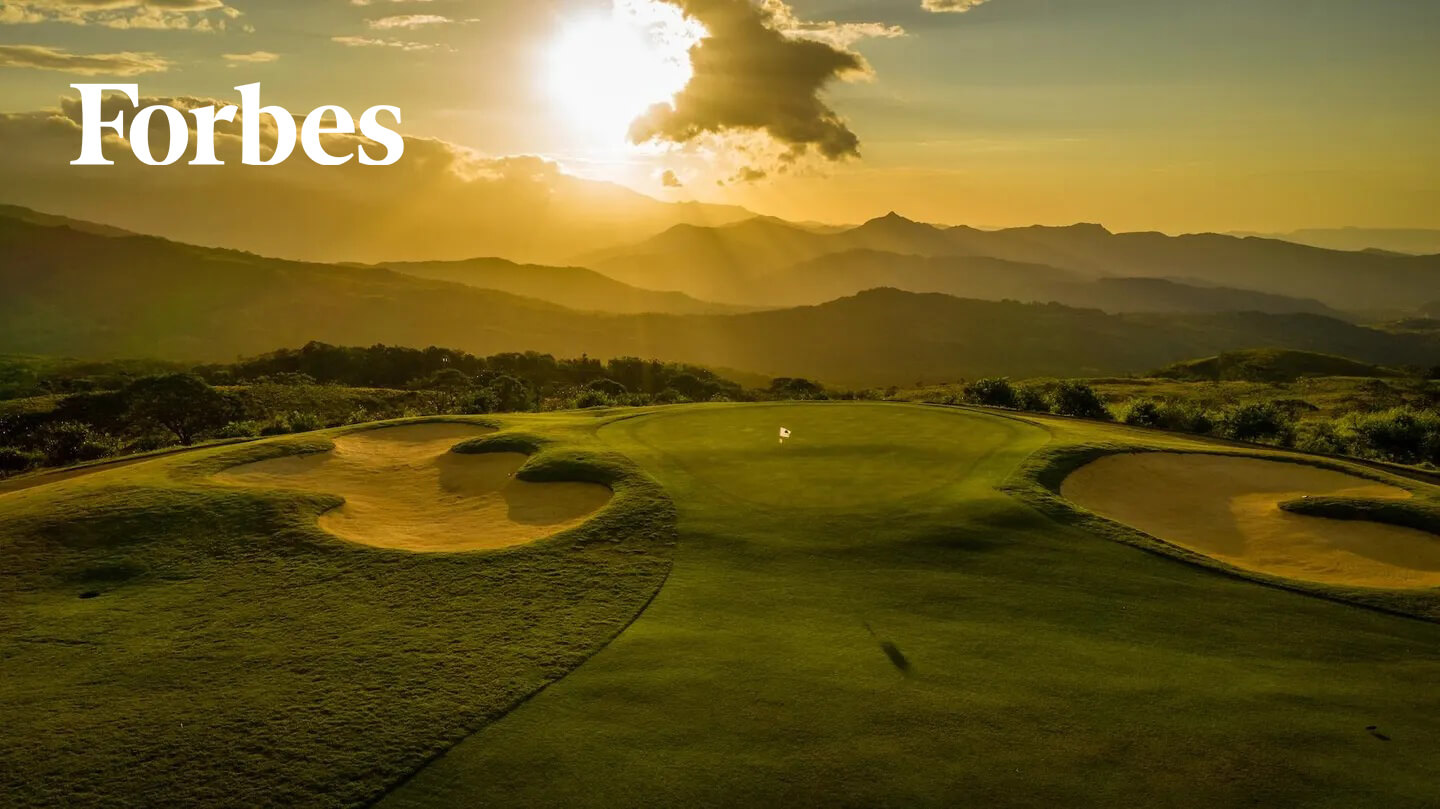
Forty-five minutes north of David (pronounced dah-VEED), Panama’s third-largest city, a few miles east of the mountain town of Boquete, is a bright green sign for a narrow two-lane road called Calle Raideep Lal that leads to the highest golf course in Central America (3,601’ above sea level to be exact).
The Indian provenance is unique for a road name here. By this point on my drive up from the Pacific coast, the heavy heat of the tidal plains has already given way to jagged mountain ridges, cloud forest, plunging rivers, and a cool, Northern California-like climate that feels like a freak of meteorology this close to the equator. We’re also approaching the solid green area in the middle of the Central American map where almost all the roads disappear: less than 30 miles from Costa Rica and La Amistad International Park to the west, equidistant between the Pacific Ocean and the Caribbean Sea north and south, and hemmed in by semi-autonomous indigenous protected areas to the east.

After banking softly right, Calle Raideep Lal coils up through tightly planted coffee farms that fan out like wine vineyards into dense swatches of lush, spongy rainforest. Depending on which way you look, the views open up on either side of the road to the mist-bound flanks of 11,401’ Volcán Barú, Panama’s highest peak, or the deep, green valleys draining this part of the North American continent down to the Pacific.
Over the past five years I’ve traveled to Panama on more than half a dozen occasions, each time growing increasingly more outspoken about sharing with the world what everyone else is missing out on. But up until now, I’ve stuck mostly to Casco Viejo, Panama City’s gawkingly well-preserved colonial historic district, the Bocas del Toro archipelago on the Caribbean side of the country, and the Pearl Islands further south of here off the Pacific Coast. This part of the country, called the Chiriqui Highlands, feels more like wild Hawaii. Or Indonesia.

I’ve come here at the invitation of Sandeep Lal, an entrepreneur-turned-“reluctant developer” who’s currently bringing to life one of Panama’s most potentially transformative real estate projects — the plainly, if aptly, named Lucero Golf & Country Club — a statement I don’t make lightly. If you write about supertall skyscrapers or Miami’s hyper-frothy housing market, as I frequently do, every new development these days comes wrapped in the ‘transformational’ label. Yet, few actually change anything consequential. Even fewer have the potential to do something profound and ignite a new narrative about a place that shifts how an entire neighborhood, city, or even a country is preceived from the outside in.
Lucero immediately felt like it had that potential. For as long as I’ve been coming to Panama, it’s seemed like everyone is waiting for the ‘Guggenheim Moment’ to happen: for that one alchemizing project to break ground that finally elevates Panama to its rightful place on the coveted global real estate map, the way the aforementioned museum did for Bilbao, Spain, Amanpuri did for Phuket, Thailand, and the first ‘eco-lodges’ did for Costa Rica back in the 1980s — transforming it from a small-scale banana and coffee exporter into the international poster child for sustainable, community-based tourism.


Lucero is not a Frank Gehry. But it possesses the scale, sophistication, and serendipity to be the kind of tipping point project that everyone in Panama has been hoping for. With over 700 contiguous acres to work with, zoning for 450 homes (40 are already built), an 18-hole, championship golf course designed by J. Michael Poellot (a protégé of Robert Trent Jones) already playing, a world-class country club and racquet sports center currently under construction, no debt or bank financing, and the choicest property of all along the 14th hole reserved for a branded luxury hotel and residences by the likes of a Montage, Ritz Carlton, or Four Seasons, Lucero has the capacity to launch Boquete into primetime — which would be a powerful, natural accelerant for a town already considered one of the best places to retire and famous for growing the world’s most expensive coffee (one kilogram sold for more than $30,000 at auction here last year).
That, in turn, might just light the fuse that makes everyone finally realize that Panama is one of the last, best kept real estate and hospitality secrets in the Western Hemisphere still hiding in plain sight.